Family budget spreadsheet: how to set up a monthly budget that works
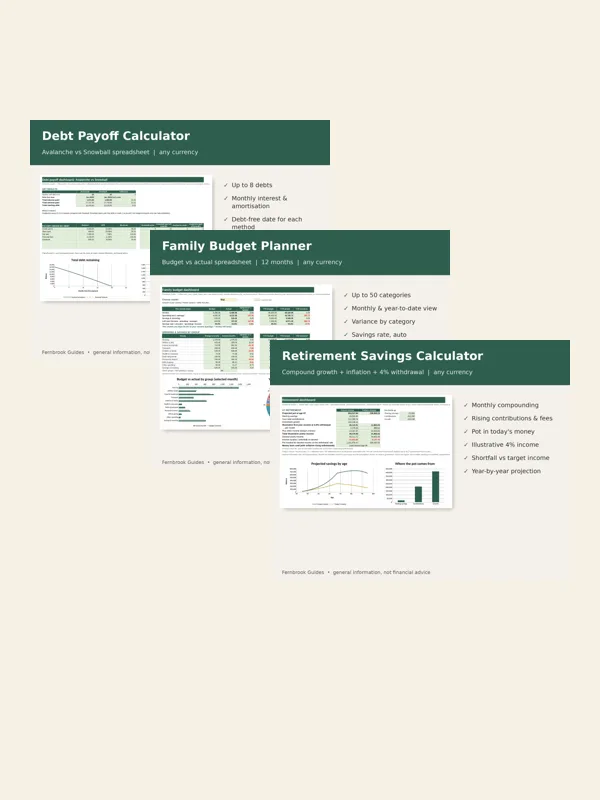
A family budget spreadsheet gives you one place to see what comes in, what goes out and what is left. It does the sums for you, so the monthly check takes minutes rather than an evening. This guide walks through a simple set-up you can use from January 2027 or start today.
Not financial advice. This guide is general information to help you organise your own money. It is not personal financial advice and no particular result is promised.
Step 1: list your monthly income
Write down every regular amount that reaches the household each month after tax: salaries, benefits, child maintenance and any regular side income. If income changes month to month, use a cautious average of the last three months rather than your best month.
Step 2: list fixed bills
Next, add the bills that are the same, or nearly the same, every month: rent or mortgage, council tax, energy, water, phone, broadband, insurance and childcare. Include annual costs too by dividing them by twelve, such as car tax or a yearly subscription.
Step 3: set limits for everyday spending
Groceries, fuel, school costs, clothes and treats change every month. Give each a realistic monthly limit based on recent bank statements. Planning meals for the week is one of the easiest ways to keep the food line steady; our guide to a January meal plan to save money shows how.
Step 4: budget against actual
The key column in any family budget spreadsheet is actual spending next to the budget. At the end of each month, enter what you really spent. The difference, or variance, shows where the plan worked and where it needs adjusting. Small overspends are normal; look for lines that go over every month and raise or cut them.
Step 5: track your savings rate
Your savings rate is the share of income left after spending. Watching it month by month is often more motivating than watching a single balance. Even a small percentage set aside each month builds an emergency fund and helps with costs like Christmas. Our guide to saving for Christmas weekly shows one way to spread a big cost.
Step 6: add your debts
If you have credit cards or loans, list each balance, rate and minimum payment. A debt payoff calculator can compare the snowball method (smallest balance first) with the avalanche method (highest rate first) and estimate a debt-free date. See our debt snowball spreadsheet guide for the details.
Keep it simple
- Review once a month on the same day, ideally just after pay day.
- Agree the main limits together as a family.
- Keep a small buffer line for surprises.
- If money worries feel heavy, free and impartial help is available from services such as MoneyHelper (named for information only; no connection or endorsement).
Spreadsheets that can help
- Money Spreadsheets Bundle (€19.99): a family budget planner, a debt payoff calculator and a retirement savings calculator together.
- Family Budget Planner Spreadsheet (€8.99): budget vs actual, variance and savings rate, monthly and year to date.
- Debt Payoff Calculator Spreadsheet (€7.99): avalanche vs snowball, debt-free date, interest and payment schedule.
FAQ
What should a family budget spreadsheet include?
Monthly income, fixed bills, everyday spending limits, actual spending next to the budget, savings and any debts.
How often should I update my budget?
Once a month is enough for most families, ideally just after pay day. Some people also do a quick weekly check on food and fuel.
Is this financial advice?
No. It is general information only. For personal help, contact a free, impartial service such as MoneyHelper.
Written with AI assistance. General information only, not financial, tax, legal, medical or educational advice; no particular outcome is promised. Price includes VAT where applicable (collected by Lemon Squeezy, our merchant of record).