Debt snowball tracker printable: colour in your way to a zero balance
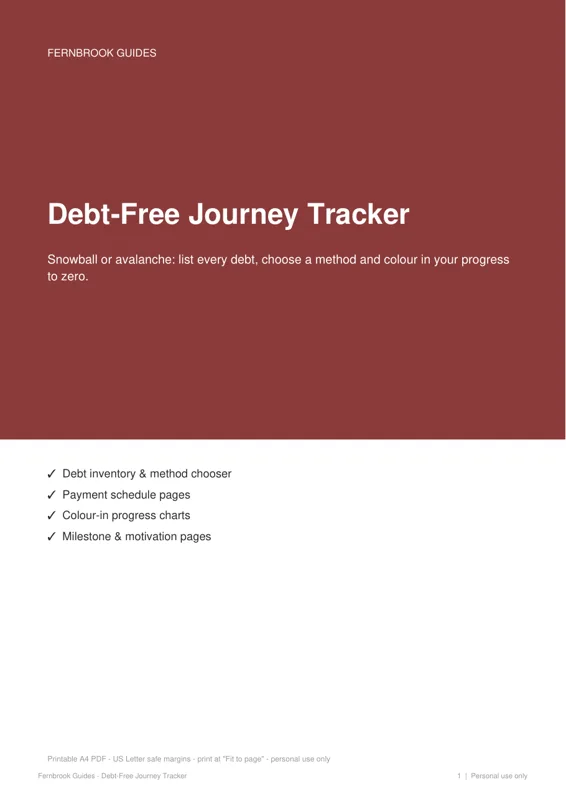
A debt snowball tracker printable is a simple sheet you keep on the fridge or in a folder, where every payment you make turns into a coloured block. It does not change the maths of paying off debt, but it makes progress visible, and for many people that is what keeps a plan going past February. This guide explains how the snowball method works, how to set up a paper tracker, and how to use it alongside a spreadsheet if you like numbers. You can start today with our free debt payoff colour-in tracker (one A4 page, no email needed).
Not financial advice. This guide is general information to help you organise your own money. It is not personal financial or debt advice, Fernbrook is not a debt advice service, and no particular result is promised.
What the debt snowball method is
With the snowball method you pay the minimum on every debt, then put any extra money you can find towards the debt with the smallest balance. When that one is cleared, you add its payment to the next smallest, so the amount you throw at each debt grows like a snowball rolling downhill.
The alternative is the avalanche method, which targets the debt with the highest interest rate first. Avalanche usually costs less interest in total; snowball gives you quicker wins. Our debt snowball spreadsheet guide compares the two with a worked example. A printable tracker works with either order.
Why a printable tracker helps
- You see it every day. A chart on the wall is harder to ignore than a file you have to open.
- Small wins count. Colouring a block for each payment rewards the habit, not just the finish line.
- It is shared. Partners and older children can see the plan, which makes spending conversations easier.
- No logins. Paper works when the phone is flat or the budgeting app has changed its pricing.
Step 1: List every debt
Gather your latest statements and write down, for each debt: the lender, the type (card, loan, overdraft, buy now pay later), the current balance, the interest rate, the minimum payment and the due date. Include small balances you might be tempted to leave off; they are often the first snowball wins.
Before you choose an order, mark any priority debts: rent or mortgage arrears, Council Tax, energy bills, court fines and child maintenance. Free debt advice services generally treat these as priority debts, because missing them can have the most serious consequences, such as losing your home or your energy supply. If you have any, speak to one of the free services below before you pick a method.
Step 2: Choose your order
For a snowball, sort the non-priority debts from the smallest balance to the largest. Number them 1, 2, 3 and so on. If two balances are close, you can put the one with the higher rate first. Write the order on the tracker so it is clear which debt gets the extra money this month.
Step 3: Find your snowball amount
Add up all the minimum payments. Then look at your budget for any amount you can add on top every month, even if it is small. That extra is your snowball. Common places people find it:
- cancelling or pausing subscriptions you no longer use
- a planned food shop instead of top-up trips (see our January meal plan to save money)
- part of a tax refund, bonus or gift money
- selling things you no longer need
Be realistic. A snowball of £25 a month that you keep paying beats £150 that you abandon in March.
Step 4: Set up the colour-in chart
Our free tracker has six bars, one per debt, each split into 20 blocks. Each block is 5% of that debt's starting balance. Write the lender and starting balance above each bar. Every time the balance drops by another 5%, colour a block, starting from the top. When a bar is full, that debt is cleared.
Illustration only. If a store card starts at £400, each block is worth £20. A £60 payment that cuts the balance by £45 after interest fills a little over two blocks. Colour two, and carry the rest over to next month.
Step 5: Update it on pay day
Pick one regular moment, such as the day after pay day, to update the tracker. Check each balance on the statement or app (interest and fees mean it may not fall by exactly what you paid), colour the blocks, and note the date. When a debt is cleared, circle the next one and write its new, bigger payment next to it.
Step 6: Keep going when it feels slow
- Celebrate milestones cheaply: the first debt cleared, a quarter of the total paid, halfway.
- Avoid new borrowing. A small emergency fund, even a few hundred pounds, can stop a broken boiler becoming new debt.
- Review once a quarter. If your income or rates change, re-check your order and amounts.
- Plan the irregular costs. Christmas, car repairs and birthdays are the usual reasons people borrow again. A yearly budget plan for 2027 with sinking funds helps.
Paper tracker or spreadsheet?
You can use both. A spreadsheet is good at the arithmetic: it adds monthly interest, rolls payments over and estimates a debt-free date. A paper tracker is good at motivation. Many people run the numbers once in a spreadsheet, then track progress on paper each month. If you are starting the year with a budget review, our new year budget reset guide walks through it step by step.
When to get help
A tracker is an organising tool, not a solution to serious money problems. If you are missing payments, borrowing to pay for essentials, or being contacted by collectors, speak to a free advice service before choosing a method. They can talk to lenders, check your options and help with priority debts. If debt is worrying you, free and impartial help is available: in the UK from MoneyHelper, StepChange or National Debtline; in Ireland from MABS; in Portugal from the DECO consumer association. These services are named for information only; Fernbrook is not connected with them, receives nothing for mentioning them, and no endorsement is implied.
Printables that can help
All Fernbrook printables are original layouts. Created with AI assistance.
- Debt-Free Journey Tracker (€5.99): debt inventory, method chooser, payment logs, six colour-in charts, a total debt countdown and milestone pages.
- Debt Payoff Snowball Planner (€9): a spreadsheet that plans up to 10 debts month by month, snowball or avalanche, with an estimated debt-free date.
- New Year Money Reset Bundle (€20.99): the tracker, the snowball planner, the Paycheck Budget Reset and the Weekly Meal Planning System in one download.
- Budget & Debt Printables Bundle (€12.99): our budget and debt printables in one purchase.
Not ready to buy? Print the free debt payoff colour-in tracker first.
FAQ
What is a debt snowball tracker?
A printable chart where you list your debts in snowball order and colour in a block each time a balance falls, so you can see your progress at a glance.
Is snowball or avalanche better?
Avalanche usually costs less interest; snowball clears individual debts sooner, which some people find motivating. Either can help if you keep up the payments; neither guarantees a result.
How often should I update my debt tracker?
Once a month, ideally the day after pay day, using the balances on your latest statements.
Is this financial advice?
No. It is general information only. For personal help with debt, contact a free, impartial service such as MoneyHelper, StepChange, National Debtline, MABS or DECO.
Written with AI assistance. General information only, not financial, tax, legal or travel advice; no particular outcome is promised. Price includes VAT where applicable (collected by Lemon Squeezy, our merchant of record).