Budget planner 2027 (UK): how to plan your money for the whole year
A budget planner for 2027 helps you see the whole year at once, not just the next pay day. Most UK households know their monthly bills, but the costs that break a budget are the ones that arrive once or twice a year: the car service, the insurance renewal, school trips, birthdays and Christmas. This guide shows you how to build a simple yearly plan, with a money calendar, sinking funds and a quarterly check-in, so 2027 has fewer surprises. Our free sinking funds tracker gives you a printable page to start with.
Not financial advice. This guide is general information to help you organise your own money. It is not personal financial or debt advice, Fernbrook is not a debt advice service, and no particular result is promised.
Step 1: Start with your monthly baseline
Before planning the year, know your normal month. List your take-home income and the dates it arrives, then your fixed bills: rent or mortgage, Council Tax, energy, water, phone and broadband, insurance, transport, childcare and debt repayments. Add a realistic figure for food and everyday spending. Income minus all of this is what you have left for savings, goals and the yearly costs below.
If you are paid weekly or fortnightly, plan by pay day rather than by month; our guide on budgeting when you are paid weekly explains how.
Step 2: Build a 2027 money calendar
Take a sheet with twelve boxes, one per month, and write in every cost you already know is coming. Some common UK dates to check:
- January: if you file a Self Assessment tax return, GOV.UK gives 31 January 2027 as the deadline for the online return for the 2025 to 2026 tax year and for paying any tax owed (paper returns are due earlier, by 31 October 2026). Check the GOV.UK deadlines page for your own dates. Also note any balance left from Christmas.
- March and April: new Council Tax bills for the year starting in April (England, Scotland and Wales). GOV.UK says the bill is usually split into 10 monthly payments, and you can ask your council to spread it over 12 instead. Your bill shows your own payment dates.
- Spring and summer: holidays, weddings and school breaks.
- August and September: school uniform, shoes and equipment.
- Every three months: Ofgem sets the energy price cap level every three months (England, Scotland and Wales). It limits unit rates and standing charges on standard variable tariffs, not your total bill, and does not cover fixed tariffs. It can be worth checking your tariff when a new level is announced.
- Your own renewal dates: car insurance, MOT and servicing, home insurance, the TV licence, breakdown cover, annual subscriptions and memberships.
- Birthdays, anniversaries and Christmas.
Next to each cost, write an estimate. Last year's statements are the best guide. Where you are not sure, round up.
Step 3: Turn yearly costs into sinking funds
A sinking fund is money you put aside little by little for a cost you know is coming. Divide the expected cost by the number of weeks or months until it is due, and save that amount each pay day.
Illustration only. Suppose car insurance renews in September at about £540 and you start in January. That is roughly £60 a month for nine months. A £300 Christmas budget started in January is about £25 a month, or under £6 a week. Your own figures will be different.
You can keep sinking funds in one savings account and track each one on paper, or use separate saving spaces if your bank offers them. The free sinking funds tracker has six rows of 13 weekly boxes: shade one each time you pay in. For Christmas in particular, see how to save for Christmas weekly.
Step 4: Give every pay day a job
Once you know your sinking fund amounts, add them to your budget as if they were bills. A zero-based approach is one option: each time you are paid, assign every pound to bills, everyday spending, debt repayments, sinking funds or savings, until nothing is left unassigned. The new year budget reset guide walks through this in six steps.
If the numbers do not fit, look at the calendar again. Can a cost be reduced, moved or spread? Could a renewal be shopped around? It is better to discover a gap in January than in September.
Step 5: Plan for the "extra" months
If you are paid weekly, usually four months a year have five pay days instead of four (in 2027, weekly Friday pay days fall five times in five months, because the year starts and ends on a Friday). Check your own pay dates on a 2027 calendar. If you are paid every four weeks, one month usually has two pay days. Decide in advance what that extra pay will do: top up a sinking fund, overpay a debt, or build an emergency fund. Writing it on the calendar stops it disappearing into everyday spending.
Step 6: Set yearly goals, but keep them small
Pick two or three money goals for 2027 and write them at the top of your plan. Examples: build a starter emergency fund, clear one card, or pay for Christmas without borrowing. If debt is a goal, our debt snowball tracker printable guide shows how to track progress on one page.
Step 7: Review every quarter
Book four short check-ins: early April, July, October and January. Each time, compare what you planned with what you spent, update the calendar with any new dates, check sinking fund balances and adjust the amounts. A 20-minute quarterly review keeps a yearly plan realistic.
Common mistakes to avoid
- Forgetting irregular costs. Go through a full year of statements to find them.
- Planning with your best month. If your income varies, use a lower-earning month as the base.
- No buffer. Leave a small amount unallocated each month for things you could not predict.
- Giving up after one bad month. Adjust and carry on; the plan is a guide, not a test.
If money is tight
If your plan shows that essentials cost more than you earn, you are not alone, and free help is available to check benefits, grants and payment options. If debt is worrying you, free and impartial help is available: in the UK from MoneyHelper, StepChange or National Debtline; in Ireland from MABS; in Portugal from the DECO consumer association. These services are named for information only; Fernbrook is not connected with them, receives nothing for mentioning them, and no endorsement is implied.
Printables and spreadsheets for 2027
All Fernbrook printables are original layouts. Created with AI assistance.
- Paycheck Budget Reset (€9): a zero-based budget workbook with an income map, bill calendar, sinking funds and monthly budget pages.
- Weekly-Paid Budget Planner (UK) (€6.99): a pay-day bill splitter, bill calendar, sinking funds and 13 weekly budget pages.
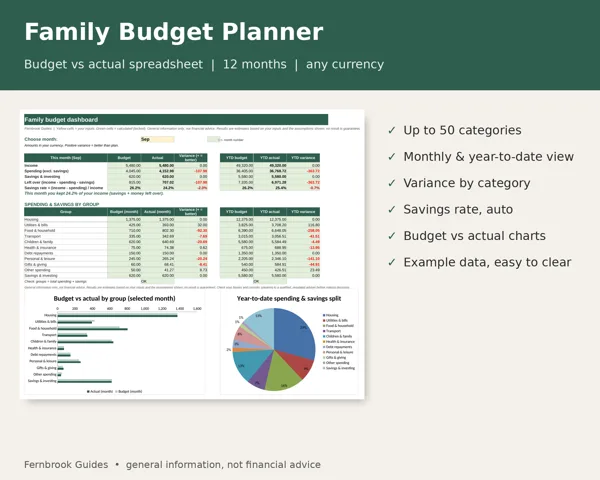
- Family Budget Planner spreadsheet (€8.99): budget vs actual, variance and savings rate, monthly and year to date.
- Christmas Savings Planner (€4.99): savings trackers for next Christmas.
- New Year Money Reset Bundle (€20.99) and Money Spreadsheets Bundle (€19.99): bundles if you want the full set.
FAQ
How do I make a yearly budget in the UK?
Work out your normal monthly income and bills, list every yearly or irregular cost on a 12-month calendar, turn each one into a sinking fund, and review the plan every quarter.
What are sinking funds?
Money you save regularly for a known future cost, such as car insurance, birthdays or Christmas, so the full amount is ready when it is due.
When should I start a budget for 2027?
Any time, but planning in November or December lets you spread costs such as Christmas 2027 across the full year.
Is this financial advice?
No. It is general information only. For personal advice, contact a free, impartial service such as MoneyHelper, StepChange, MABS or DECO.
Written with AI assistance. General information only, not financial, tax, legal or travel advice; no particular outcome is promised. Price includes VAT where applicable (collected by Lemon Squeezy, our merchant of record).