How to save for Christmas weekly: how much to put aside each week
If you are wondering how to save for Christmas weekly, the answer is a simple plan. A Christmas savings plan turns one big December bill into lots of small, manageable amounts. The idea is simple: decide what Christmas will cost, count the weeks until you need the money, and divide. This guide shows how to do that, with worked examples, and how to keep the plan going when money is tight.
Step 1: Set your Christmas target
Start with a realistic total. Include gifts, food and drink, hosting, travel to see family, cards and wrapping, and any events or outings. If you kept notes from last year, use them. Otherwise, list each category and give it a rough figure. Our guide on how to budget for Christmas gifts helps with the gifts part.
Then subtract anything already put aside. What is left is your savings target.
Step 2: Count the weeks
Count the weeks from now until the date you will start spending. That is often early December, not Christmas Day, because many people buy gifts and order food a few weeks ahead. If you plan to shop in November, count to then.
Step 3: Divide: your Christmas savings plan per week
Weekly amount = savings target ÷ number of weeks.
Some worked examples (figures are only illustrations):
- Target €300, 10 weeks to go: €300 ÷ 10 = €30 a week.
- Target €300, 30 weeks to go: €300 ÷ 30 = €10 a week.
- Target €600, 20 weeks to go: €600 ÷ 20 = €30 a week.
Example: save for Christmas in 8 weeks
Illustration only. Say it is late October, your target is €240 and you want the money by mid-December, about 8 weeks away: €240 ÷ 8 = €30 a week. If €30 is too much, a €160 target over the same 8 weeks is €20 a week.
The examples show why starting early matters: the same target costs a third as much per week when you have three times as long.
Step 4: Check it fits your budget
Compare the weekly amount with what is genuinely left after essentials. If it does not fit, you have three levers: lower the target, start spending later (more weeks), or find a small saving elsewhere. Lowering the target now is far less stressful than discovering in December that the money is not there. If you are paid weekly, our guide on budgeting when you're paid weekly shows how to fit a savings line into each pay week.
Step 5: Make saving automatic
The plan works best when the money moves without you having to remember. Options include:
- a standing order into a separate savings account on payday
- a savings "pot" or "space" in your banking app, if your bank offers one
- cash in labelled envelopes, if you prefer cash
Keeping Christmas money separate from your everyday account makes it less likely to get spent by accident. If you use a savings product, check its terms, such as access rules and any protection scheme, with the provider.
Step 6: Track your progress
Write down each week's deposit and the running total. A simple tracker you colour in or tick off is surprisingly motivating, and shows quickly if you have fallen behind.
If you miss a week
It happens. Recalculate rather than give up: take the amount still needed and divide it by the weeks left. For example, if you need €180 more with 9 weeks left, that is €20 a week. If the new figure is too high, trim the target.
Small ways to find the weekly amount
If the number feels high, look for a few small, regular savings rather than one big cut. Ideas people often use:
- review subscriptions and cancel any you rarely use until the new year
- plan meals for the week and shop from a list to cut unplanned food spending
- move any loose change or small refunds straight into the Christmas pot
- set aside part of any irregular income, such as overtime or a tax refund
- agree spending limits with family early, so everyone saves towards a similar figure
Each of these may only add a few euros a week, but together they can cover a good part of the plan. Write down which ones you will try, and check after a month whether they are actually happening.
Planning for the January gap
Many people are paid earlier in December, which makes January's wait for payday feel very long. When you set your target, think about whether you also want to keep some money back for January bills. Some people add a small "January buffer" line to their savings plan so the new year does not start with an overdraft. Adding it now, while the weekly amounts are small, is much easier than finding the money in late December.
Travelling to see family? Add trip costs to your target using our Christmas travel checklist.
A note on "buy now, pay later"
Spreading the cost with credit or pay-later services means you are borrowing, and missed payments can bring fees and affect your credit record. Saving ahead avoids that. If you are worried about debt, free and impartial help is available, for example from MoneyHelper in the UK, MABS in Ireland, or the DECO consumer association in Portugal.
Printables to keep you on track
If you like a visual Christmas savings challenge printable, colour in a box for each week you save.
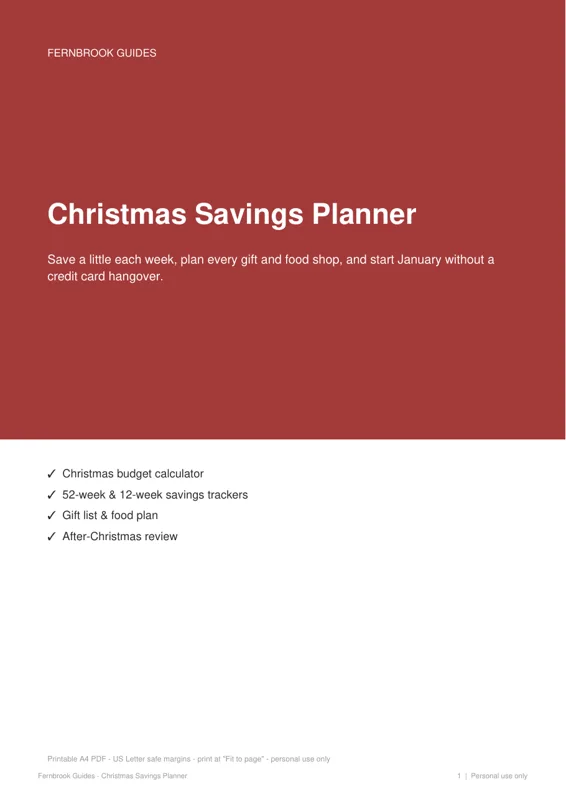
Our Christmas Savings Planner (€4.99, PDF) helps you set the target and track your savings with 52-week and 12-week trackers. For the rest of the year, the Budget & Debt Printables Bundle (€12.99) groups our budget and debt printables. For the spending side, try the free 4-page sample of the Christmas Gift Budget Planner: it's a direct download with no email needed.
FAQ
How much should I save each week for Christmas?
Divide your savings target by the number of weeks until you start spending. For example, a €300 target with 20 weeks to go is €15 a week.
When should I start saving for Christmas?
As early as you can. The more weeks you have, the smaller each weekly amount. Many people start in January or straight after the summer.
What if I cannot afford the weekly amount?
Lower the target, count to a later start date or look for small savings elsewhere. Recalculate whenever things change.
Where should I keep Christmas savings?
Somewhere separate from your everyday spending, such as a savings account, a pot in your banking app or labelled envelopes. Check any account terms with the provider.
Written with AI assistance. General information only, not financial, tax, legal or travel advice; no particular outcome is promised. Price includes VAT where applicable (collected by Lemon Squeezy, our merchant of record).