Christmas gift budget planner printable: how to budget for Christmas gifts
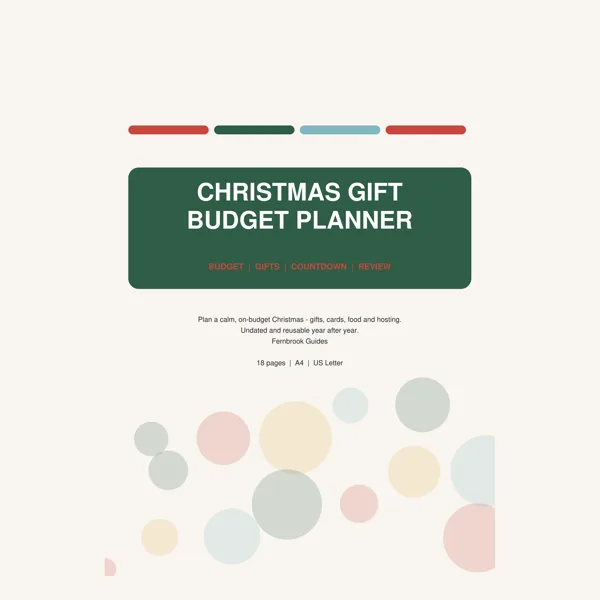
A Christmas gift budget planner printable is one of the simplest ways to keep gift spending under control. Christmas spending tends to creep. A present here, a "little extra" there, a last-minute stocking filler, and by January the total is far higher than anyone planned. A gift budget does not have to be strict or joyless. It is simply a decision, made early and calmly, about how much you are happy to spend, followed by a way of seeing where you are as you go. This guide walks through that process in seven steps.
Step 1: Start with what you can actually afford
Begin with the money, not the list. Look at what is left each month once essentials are covered: housing, bills, food, transport and any debt repayments. The gift budget should come out of that spare amount, or out of money you have already saved for Christmas. If you are starting late and the figure is small, that is useful information, not a failure. It tells you to plan smaller, more thoughtful gifts rather than relying on a card.
Write a single number at the top of the page: your total Christmas gift budget. Everything else in this guide divides that number up.
Step 2: Remember the costs that are not presents
Gifts are rarely the only Christmas expense. Before you split your total between people, set aside money for the things that usually get forgotten:
- wrapping paper, tape, gift bags and tags
- cards and postage
- delivery charges on online orders
- stocking fillers and small "just in case" gifts
- Secret Santa at work or school
- teacher, carer or neighbour gifts
Some people also fold in food, hosting and travel. If you do, give each one its own line so a big supermarket shop does not quietly eat the gift money. A simple way is to split your total into categories first (for example gifts, food and hosting, cards and wrapping, and a small buffer) and then work inside each category.
Step 3: Make a Christmas gift list
A simple Christmas gift list template has four columns: name, gift idea, budget and actual cost. Now write down every person on your list. Be honest: include the extra cousins, the office swap and the friend you always end up buying for at the last minute. Seeing the full list in one place is often the moment people realise why Christmas felt expensive last year.
Group people if it helps: close family, extended family, friends, work and school. Groups make it easier to agree a set amount per person, and to spot where a family "Secret Santa" or a shared gift could replace several separate presents.
Step 4: Set your Christmas budget by person
Next to each name, write a target amount. It does not need to be equal for everyone. Add up the column and compare it with the gift line from Step 2. If the total is too high, trim now, on paper, rather than in December at the till. Options that often work:
- suggest a family Secret Santa with a set spending limit
- buy one shared gift for a couple or household
- agree "children only" presents with other adults
- give time or something homemade instead of a bought gift
Step 5: Track actual cost, not just intentions
A budget only works if you write down what you really spend. For each person, record the gift idea, the budget and the actual cost once bought. Tick boxes for Bought and Wrapped help a lot in the busy weeks: you can see at a glance who is done and who still needs something. Keep receipts together in one envelope or folder in case anything needs returning.
Update the running total every time you buy something. If one gift comes in over budget, take the difference from another line straight away so the overall total stays where you set it.
Step 6: Keep an ideas list and buy early where it makes sense
An ideas page is useful all year. When someone mentions something they would like, write it down. Buying through the autumn spreads the cost over several months, and lets you compare prices without pressure. Be wary of buying things just because they are on offer: a discount on something not on your list is still extra spending.
Step 7: Use a December countdown
A simple 1–25 December countdown helps you plan the jobs as well as the money: last posting dates, when to wrap, when to do the food shop, when to collect orders. Spreading these tasks out makes impulse buying less likely, because you are not rushing round the shops on the 23rd.
Travelling for Christmas? Our Christmas travel checklist covers what to sort before you go.
After Christmas: a five-minute review
In early January, note what you spent compared with your budget, what worked and what you would change. It takes five minutes and gives you a realistic starting figure for next year. If saving was the hard part, our guide on how to save for Christmas weekly (Christmas savings plan) shows how to work out a weekly amount to put aside.
A free printable to get started
If you prefer pen and paper, download our free 4-page sample of the Christmas Gift Budget Planner. It includes the cover, contents, a budget-by-category page and the first gift list page, as a direct PDF download with no email needed. The full planner (€5.99, 18 pages, A4 and US Letter) adds three gift list pages, gift ideas, stocking fillers, a Christmas cards list, a food and hosting budget, the December countdown, a thank-you list and a post-holiday review.
FAQ
How much to spend on Christmas gifts?
There is no right figure. Start from what is left after essentials each month, or what you have saved, and set a total you are comfortable with. Then split it by person.
How do I stop overspending at Christmas?
Write a total budget, list everyone you buy for with a target amount, and record the actual cost of each gift as you buy it. Seeing a running total makes overspending visible early.
What Christmas costs do people forget?
Wrapping, cards, postage, delivery charges, stocking fillers, Secret Santa and small gifts for teachers or neighbours. Give them their own budget line.
Is the free sample really free?
Yes. The free 4-page sample is a direct PDF download with no email or sign-up required.
Written with AI assistance. General information only, not financial, tax, legal or travel advice; no particular outcome is promised. Price includes VAT where applicable (collected by Lemon Squeezy, our merchant of record).